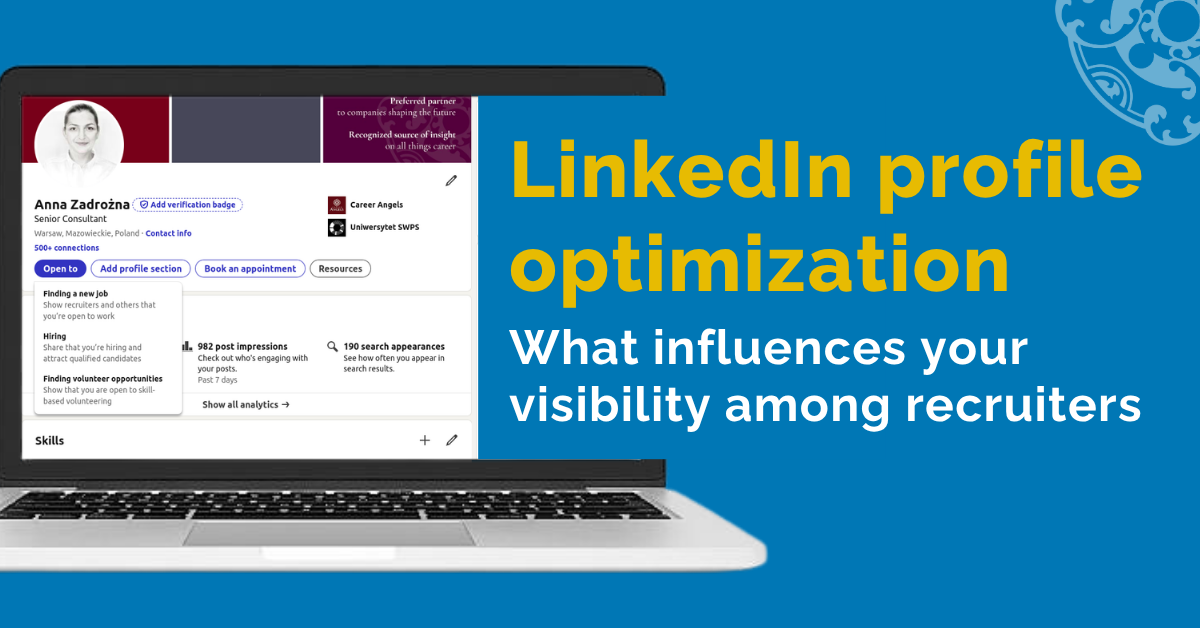
How to Optimize Your LinkedIn Profile to Increase Your Visibility Among Recruiters
LinkedIn now has more than 1.3 billion users worldwide. Every minute, more than 18,000 new connections are made on the platform and over 8,200 job applications are submitted.
However, simply being present on LinkedIn doesn’t mean that recruiters will be able to find you.
You may have a professional photo, a well-prepared headline, summary and experience section, and yet your profile may still not give recruiters a clear enough picture of your experience.
Quite recently, we discussed the basic elements of a profile: photo, headline, summary and experience. The next step is to ensure that the profile also reflects how recruiters actually search for and assess candidates.
LinkedIn Recruiter allows recruiters to filter candidates by, among other things, job title, location, company, industry, languages and skills. The platform is also developing solutions that support candidate search and matching.
This is why not only the right keywords matter, but also the context in which they appear: the level of the role, scope of responsibility, specialization and scale of experience.
Start with the Market Language
A good starting point is to analyze 5-10 job ads for roles that interest you.
Check which terms regularly appear in:
- functions and job titles,
- areas of responsibility,
- experience requirements,
- competencies,
- descriptions of the industry and scale of the role.
If job ads that interest you regularly include terms such as P&L responsibility, business transformation, expansion into new markets or change management, check whether these elements of your experience are equally clearly visible on your profile.
The goal isn’t to copy the content of job ads, but to understand the language the market uses to describe experience that you genuinely have.
Review Your Skills
Compare the competencies required for the roles that interest you with the “Skills” section of your profile.
Do the most important ones reflect your current experience and the roles you are considering? Or is the list still dominated by competencies characteristic of earlier stages of your career?
Your most important skills should also be visible in the experience section. If, for example, you list restructuring, cost optimization or the development of new business areas, the experience section should show which activities and areas you were responsible for in this context.
If you use LinkedIn Premium and your platform language is set to English, an additional source of information may be the “Show match details” feature available for some job ads. It shows the extent to which the information contained in your profile and CV matches the requirements of a particular role.
For key competencies, you can also ask people who have had the opportunity to work with you professionally to endorse them on LinkedIn.
Use Keywords in the Right Context
LinkedIn Recruiter may take into account information included in different parts of the profile.
This is why terms that are relevant to your career direction should appear naturally in the headline, summary and experience section, provided, of course, that they genuinely describe your competencies and career to date. The goal isn’t to create an artificial list of keywords.
A Job Title Alone Isn’t Enough
At managerial and executive level, a job title alone often says very little.
“Commercial Director”, “Head of Strategy” or “Managing Director” can involve completely different scopes of responsibility depending on the organization. One person may be responsible for one market and a small team, while another may be responsible for several countries, a large budget and hold full P&L responsibility.
A similar problem arises with internal job titles that are obvious within a particular organization but mean very little to someone outside it.
This is why the experience section should provide the right context. If you were responsible for several markets, a large team, a specific level of revenue, an organizational transformation or the development of a particular business area, definitely show this.
It is worth making sure that a recruiter can quickly assess the level of the role and the scale of your responsibility.
Your Profile Should Support Your Career Goal
A well-prepared LinkedIn profile doesn’t function separately from your CV or from your overall job search strategy.
If your CV positions you as a candidate for a regional role, while LinkedIn still focuses primarily on earlier, local positions, there is an inconsistency. The same applies if you emphasize your experience in business transformation during interviews, while the profile mainly shows the scope of your operational responsibilities.
So take a look at your profile from the perspective of someone who doesn’t know your career history.
Will they be able to quickly understand:
- the level of your responsibility,
- which areas you are responsible for,
- what you specialize in,
- the scale of the business and teams you were responsible for,
- what international experience you have,
- which roles your current experience is a good fit for?
If the answers to these questions aren’t clear from the profile, it is worth checking which sections need further work.
Review Your Job Search Settings
If you are actively considering a job change, it is worth reviewing the job search preferences saved in your LinkedIn settings. These include, among other things, settings related to applying for jobs, sharing your profile after clicking “Apply” and informing recruiters of your interest in new opportunities.
A separate feature is “Open to Work”, available from the profile. Here, you can specify, among other things, the roles you are interested in, locations, working model and type of employment. If your career goal has changed since the last time you updated your profile, it is worth checking whether this information is still up to date.
Information about your openness to new opportunities can be shared with all LinkedIn users or only with people using LinkedIn Recruiter. There is no one-size-fits-all solution here. The strategy of a junior manager who openly communicates that they are looking to change jobs may look different from that of a director or board member who is looking for their next role confidentially.
It is also worth remembering that LinkedIn itself states that, when visibility is limited to recruiters only, it can’t guarantee complete privacy from your current employer.
Build Your Network Deliberately
The number of connections alone isn’t the most important factor. It is worth defining your own rules regarding whom you add to your network and following them consistently.
It is a good idea to personalize invitations, especially if you don’t yet know the person. In many cases, a brief explanation of the context of the connection is enough.
Conferences, webinars and industry events are also good opportunities to expand your network. If you have just attended the same event as someone else or had the opportunity to speak with them, it is worth connecting or staying in touch afterwards on LinkedIn.
AI is Increasing the Importance of the Quality of Information on Your Profile
The importance of a well-prepared profile is also growing as recruiters use AI more widely.
In a 2026 LinkedIn survey, 93% of recruiters said they planned to increase their use of AI in their work, while 59% said that the technology helped them find people with skills they might previously have overlooked.
The greater the role technology plays in searching for and matching candidates, the more important the quality, completeness and consistency of the information contained in the profile become.
What Are the Benefits of a Well-Prepared Profile?
LinkedIn won’t replace applying for relevant job opportunities, contacting headhunters, reaching out to companies directly or networking, but it can support each of these channels.
A well-prepared profile:
- increases the chance of appearing in relevant search results,
- makes it easier to assess the level, scope and scale of experience,
- complements and reinforces the information presented in the CV,
- shows key competencies in the right context,
- supports credibility as an expert and consistent professional positioning.
Over the past 5 years, 4,863 experienced managers and executives have approached Career Angels for support with further career development, including LinkedIn. More than 80% of Career Angels clients come to us through recommendations.
When working on a LinkedIn profile, we analyze not only its individual sections, but also the profile as a whole: the career goal, positioning, consistency with the CV, the scope and scale of experience, and how the profile may be interpreted by a recruiter or headhunter.
If you are a manager or executive with at least 10 years of experience and would like to check whether your LinkedIn profile properly supports your next career move, email Contact@CareerAngels.eu to arrange a free online Career Consultation. During the meeting, we can discuss LinkedIn, CV, job search strategy or another topic related to further career development.
Don’t leave your visibility to chance. Check whether your profile really supports the next step in your career.