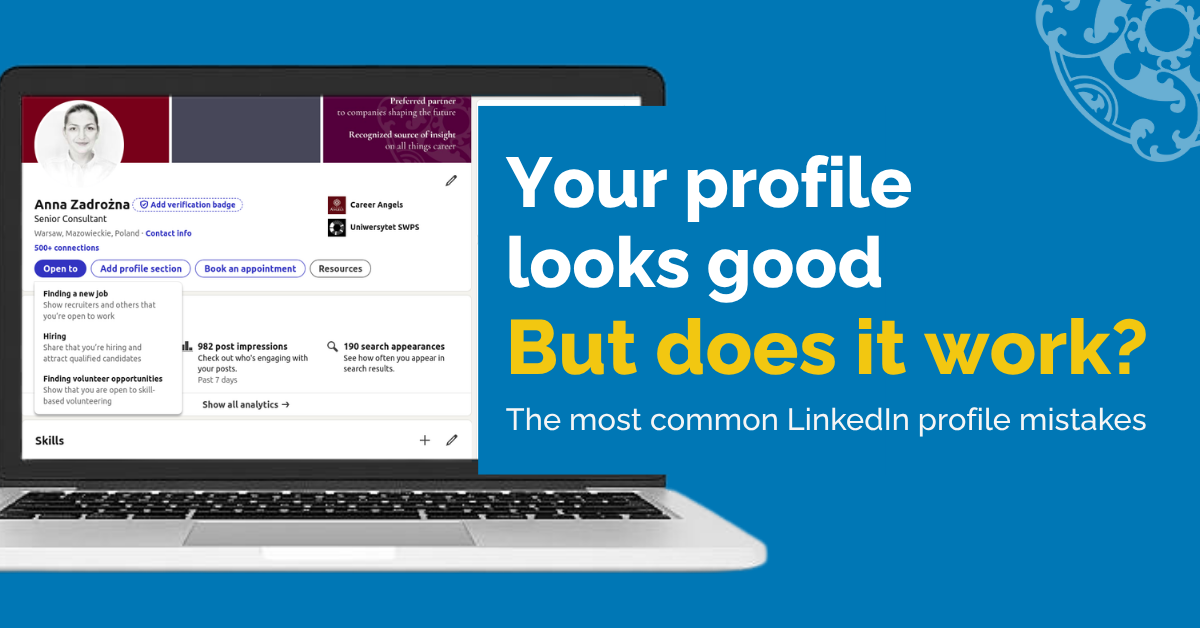
Is Your LinkedIn Profile Working for You?
You may have the relevant experience, achievements and qualifications needed to take on your next role. However, if this isn’t clearly evident in your LinkedIn profile, a recruiter, headhunter or decision maker may not find you or recognize the full value of your experience.
LinkedIn has over 1.3 billion users worldwide and remains one of the main tools used by recruiters to search for candidates. Despite this, many profiles of experienced managers and executives are still incomplete, out of date or not optimized for the algorithm.
What are the mistakes we see most often?
1. Lack of a Clearly Defined Objective
Before you start updating your profile, ask yourself three questions:
- Why am I on LinkedIn?
- Who do I want to reach?
- What do I want to be associated with?
The profile of someone looking for a new role should be different from that of an expert building their visibility in the industry, and different again from that of a candidate for a supervisory board role, an advisor or a business partner.
It’s best to focus on one main objective and, if necessary, one complementary direction. Positioning that is too broad makes it difficult for the reader to understand what you are looking for and what you specialize in.
Remember that your profile should work on two levels:
- be easy to read for people who need to quickly understand your value,
- contain information, roles, sectors, skills and keywords that help the LinkedIn algorithm categorize your profile correctly.
2. A Headline That Doesn’t Say Much
The headline appears directly below your first name and surname. It’s visible in search results, comments, messages and contact requests, among other places.
Despite this, many people only include their current job title and company name, for example:
Managing Director at XYZ
A headline like that doesn’t yet show what you specialize in or which areas you’re responsible for.
It’s also not worth using the headline “Looking for new opportunities”. While it indicates that you are available, it doesn’t explain why someone should contact you, and in some cases may undermine the way you are perceived in the market (we discuss signaling openness to offers in more detail in point 11).
A good headline can combine:
role or level of responsibility + key areas of specialization + business context
3. A Summary That Could Apply to Anyone
Terms such as “experienced leader”, “strategic manager” or “results-oriented professional” mean very little if they aren’t backed up by specific evidence.
The “About” section should highlight:
- who you are professionally,
- the areas where you are most experienced,
- the business problems you solve,
- the scale of teams, markets, budgets or operations you have managed,
- the achievements that best demonstrate your value.
Ask yourself:
Could someone else in a similar role copy my summary, making just a few minor changes?
If so, it’s probably too general.
4. Copying Your CV or Providing Too Little Information
A LinkedIn profile shouldn’t be a copy of your CV.
You usually tailor your CV to a specific role or recruitment process. LinkedIn is a broader tool for positioning yourself, building your visibility and credibility.
In the “Experience” section, focus primarily on the last 7-10 years of your career. You may wish to provide a broader context if earlier roles are relevant to your current objective.
For your most significant roles, highlight:
- your areas of responsibility,
- the scale of your operations,
- the business context,
- selected achievements,
- key projects or transformations.
Keep the format consistent and avoid disclosing confidential information. Your profile should contain enough information for the reader to understand your level and experience, but it doesn’t need to go into every detail of your career.
5. Lack of Appropriate Keywords and Skills
Recruiters do not search for candidates solely by job title. They also use terms relating to the industry, specialization, technologies, products, regions, languages and areas of responsibility.
To identify the right keywords:
- Collect 5-10 job ads for roles you’re interested in.
- Check which terms and requirements appear regularly.
- Compare them with your experience.
- Add the relevant terms to your headline, summary, experience and skills sections.
Only include skills that you actually possess and can back up with examples. You can also ask trusted colleagues, managers or clients to endorse your key skills directly on your profile.
6. An Incorrectly Selected Industry
A job title isn’t the same as an industry.
If you are the CFO of a company that manufactures and sells food, your sector is likely to be FMCG or manufacturing, rather than financial services.
If you are targeting a new sector and have experience or achievements that credibly support this direction, you might consider choosing a target industry. If several sectors are relevant to your profile, choose the one that is currently your priority.
It’s a minor detail, but it can affect the context in which your profile appears in search results.
7. A Photo and Background That Don’t Support Your Professional Image
Your profile picture should be up-to-date, clear, well-lit and appropriate for the professional environment in which you wish to work.
A classic head-and-shoulders shot works best, with a plain background, a natural facial expression and direct eye contact with the camera.
The background image should be consistent with the professional image you wish to project. A safe choice is a neutral or single-color background that doesn’t distract from the most important information on your profile.
Be wary of random decorative images, including landscapes, poor-quality photos and graphics containing too much text. Rather than enhancing your profile, they may make it harder for viewers to focus on the key elements of your profile. An exception might be a background required by company policy.
8. Incomplete or Inconsistent Information
Check that you have included:
- a current and professional email address,
- relevant websites (e.g. company website, portfolio),
- a personalized link to your profile,
- the languages in which you are comfortable working (including your native one),
- your education and relevant courses.
Also ensure that your first name and surname are consistent across all application documents. If you use a middle name or initial on LinkedIn, use the same form in your CV and email signature.
A personalized profile link should be short and easy to include in a CV, presentation or email signature, for example:
linkedin.com/in/namelastname
rather than the default address containing an additional string of numbers.
9. Unused Additional Sections
You don’t have to fill in every section available. Choose the ones that strengthen your positioning.
It’s worth considering, among other things:
- interim projects and assignments that you can disclose,
- current and relevant awards or distinctions,
- memberships of organizations and roles on boards and committees,
- publications, presentations and media coverage,
- recommendations from people who can credibly describe your strengths, your approach and the results you have achieved.
When it comes to recommendations, quality matters more than quantity. The most valuable ones highlight the context in which you worked together, specific strengths and the results achieved.
10. A Network of Connections That Is Too Small or Random
Your network of connections should be appropriate to your experience, role and professional activities.
For a manager with over 10 years of experience, having fewer than 200 connections may suggest that the profile is rarely used or out of date. For CEOs, board members and senior executives, it’s worth aiming for more than 500 connections.
However, this isn’t about randomly adding people you don’t know. Build your network thoughtfully, including:
- current and former colleagues,
- clients and business partners,
- recruiters and headhunters,
- people in your industry,
- alumni of the same universities and programs,
- people you meet at events and conferences.
When sending an invitation, add a brief, personalized note explaining the context. After a meeting or conversation, a simple message referring to your previous interaction will suffice.
You should also check the visibility settings for your contact list and decide whether you want to share it with others.
11. The Wrong Job Search Settings
If you’re open to career opportunities, complete your job search preferences and configure the “Open to” setting.
LinkedIn allows you to share information that you are open to job opportunities:
- with all users of the platform,
- exclusively with users of LinkedIn’s recruitment tools.
The first option adds a green frame to your profile picture. For experienced managers and executives, we do not generally recommend this approach. It’s better to make your “Open to Work” status visible to recruiters only, bearing in mind that LinkedIn doesn’t guarantee that this information will remain completely hidden from your current employer.
Draft the Content Before Updating LinkedIn
It’s best to draft the strategic sections of your profile in a separate document first. This will make it easier for you to maintain consistency, avoid unnecessary repetition and check your use of keywords.
Once you have prepared a draft:
- check the language, dates and job titles,
- ask a few people from your target audience for their opinion,
- ask them what they see as your key professional strengths or areas of expertise, and which roles they think would be a good fit for you,
- make the necessary changes.
Next, update your LinkedIn profile. Add the prepared content section by section, and finally check how the profile looks on both a computer and the mobile app.
Why Is a Well-Prepared Profile Important?
A strong profile doesn’t guarantee a job offer. However, it can increase the likelihood that the right people will:
- find you in search results,
- gain an accurate understanding of your experience,
- recognize your level of responsibility,
- contact you about a suitable opportunity.
A LinkedIn profile can help not only with job search, but also with networking, building visibility, attracting clients, establishing partnerships and being approached about supervisory board roles.
Get a Free Assessment of Your Profile
It isn’t easy to assess your own profile. It’s even harder to judge whether your profile truly reflects your level, career direction and value from the perspective of a recruiter, headhunter or decision maker.
Over the past five years, 4,840 experienced managers and executives have come to us for guidance, seeking specific answers or an independent perspective on their career situation. Over 80% of our clients come to us through referrals.
We offer a free and confidential LinkedIn Report designed for managers and executives with at least 10 years of experience. It includes a section-by-section analysis of your profile and specific recommendations on which changes to make first.
Each report is prepared individually by a member of our team and delivered within 2-3 business days.
To receive it, email us at Contact@CareerAngels.eu, with “LinkedIn Report / Blog” in the subject line, and include a link to your profile.
Don’t wait until you urgently need your profile before updating it. Make sure it shows not only what you’ve done so far, but also what you are ready for next.