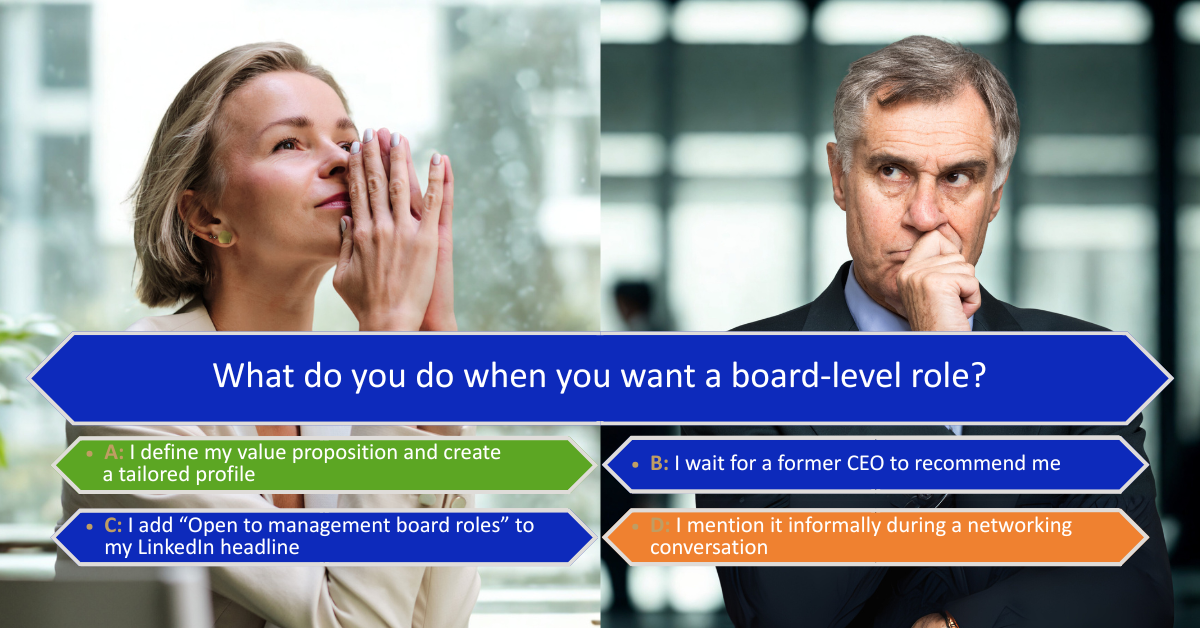
Are You Ready for a Supervisory or Management Board Role? What Should Your First Step Be?
“Is my experience strategic enough for me to consider a role on a supervisory or management board?”
How can I show my value beyond my current job title?
Should I communicate this change publicly, or rather build it discreetly?
Is it enough that I have a strong reputation in the industry?
Who should actually know that I’m open to supervisory or management board roles?”
For many experienced managers and executives, the transition from an operational, expert or functional role to a management board, or from an executive role to a supervisory board, is a natural next step in their career.
At this level, however, it isn’t only about how many years of experience you have, how large the teams you have led were, or what positions you have held. Supervisory or management board roles require a different way of positioning yourself. What matters isn’t only your professional background, but also the strategic perspective you bring, the areas in which you can realistically increase the value of an organization, and whether your experience is better suited to an executive or supervisory role.
This is the moment when your existing CV or LinkedIn profile may no longer be enough. You need a clear narrative that demonstrates your value from the perspective of business owners, investors, CEOs, nomination committees, or people who make decisions about appointments to supervisory or management board roles.
Let’s look at the options you have when you’re ready to move into a supervisory or management board role.
1. Define Your Value Proposition and Create a Tailored Profile for Supervisory or Management Board Roles
Why it may not work: Creating a profile for supervisory or management board roles alone isn’t enough if you treat it as a shortened version of your CV. This type of document shouldn’t be a list of positions, responsibilities and projects. If it lacks clear positioning, a competence profile at supervisory or management board level, and a specific answer to the question “why you?”, even very impressive experience may be perceived as too operational or too broad.
When it may work: This is the best starting point if you approach it strategically. A strong profile for supervisory or management board roles shows the areas in which you bring value, for example transformation, business scaling, governance, P&L, compliance, ESG, M&A, international expansion, digitalization, risk management, succession, cooperation with the management board or organization building. It also helps structure your experience so that it is clear to people who make decisions about appointments to management or supervisory board roles. At this stage, the key is to translate your previous achievements into a clear, concise and credible value proposition.
2. Add “Open to Management Board Roles” to Your LinkedIn Headline
Why it may not work: Such a message may seem specific, but at executive level it usually works against the candidate. A LinkedIn headline is an element of positioning, not a noticeboard. If you write that you are “looking for a supervisory or management board role” but fail to show what value you can bring, in what context and for what types of organizations, you risk weakening your image. You may be perceived as someone simply looking for a function, rather than as a leader who brings a specific strategic perspective. At senior level, communication based on value works much better than communication based only on availability. Visibility is important, but it should be planned. Especially when your current position, reputation or business relationships require discretion.
3. Wait for a Former CEO to Recommend You
Why it may not work: Recommendations are very important when moving into supervisory or management board roles, but passively waiting for a recommendation limits your opportunities. A former CEO may value your work, but may not necessarily know that you want to develop towards supervisory or management board roles. They may also not know how to present you in this context. Reputation helps, but on its own it is rarely enough. If others associate you mainly with your previous operational role, they may not see you as a natural candidate for a supervisory or management board. You need a clear message that makes it easier for people in your network to understand what types of opportunities are interesting to you and where exactly you can help.
4. Mention It Informally During a Networking Conversation
Why it may not work: An informal networking conversation can sometimes open interesting doors, but it rarely replaces conscious positioning. If you tell someone that you “would like to join a supervisory or management board”, you may receive a polite nod, but not necessarily a concrete recommendation. Without a clear value proposition, it is difficult for others to remember what type of role you are looking for, what types of organizations you are suited for, and why someone should recommend you. There is also a risk that the message will sound too general. In the case of these roles, simply declaring interest is usually not enough. The person who could recommend you needs to immediately understand what type of organization and business situation you fit, and why your candidacy makes sense.
5. Assume That an Executive Position Automatically Qualifies You for a Supervisory or Management Board Role
Why it may not work: Many experienced leaders assume that if they have held a C-level or General Manager role, moving into a supervisory or management board is a natural and obvious next step. Sometimes it is. Often, however, the market needs an additional explanation. A management board role requires moving beyond the perspective of your own function and showing responsibility for the whole business, strategy, results, risk and stakeholders. A supervisory board role, in turn, requires a shift from operational management to supervision, governance, risk assessment, asking the right questions and supporting long-term decisions. If your communication shows only execution and operational management, it may not build trust in your readiness for supervisory or management board level.
6. Prepare a Standard CV and Send It to Your Friends
Why it may not work: A standard CV usually shows your career history, scope of responsibility and achievements. This is important, but it doesn’t always answer the questions that matter for supervisory or management board roles. People who recommend you further need short, precise material that immediately shows your areas of expertise, the types of organizations you are suited for, and the value you can bring. If you send a document that is too long, too operational or too general, the recipient may not know how to read it correctly in the context of your ambitions. As a result, even supportive people in your network may not be able to recommend you effectively.
7. Respond to Every Visible Supervisory or Management Board Role
Why it may not work: Supervisory or management board roles often don’t work like standard recruitment processes. Some of them are published publicly, but many are filled through networks, recommendations, investors, owners, executive search firms or closed nomination processes. Acting without a strategy can lead to frustration, especially if you don’t yet have a refined profile for supervisory or management board roles and a clear message. At this level, the quality of positioning and relationships matters more than the number of applications sent. Before you start actively signaling your availability, it is worth making sure that your materials, LinkedIn profile and networking conversations all support the same message.
So, What’s the Best Option for a Senior Professional?
Given who has prepared this post, you know what we’ll suggest ;)
Ask a Career Consultant who specializes in senior professionals and executives for advice. Someone who:
- understands the difference between executive positioning and positioning for supervisory or management board roles,
- can help you define your value proposition for supervisory or management board roles,
- knows how to translate complex leadership experience into a clear, strategic profile,
- will help you prepare communication that is credible, discreet and aligned with your goals.
Over the past five years, we have advised 4,741 experienced managers and executives who expected a straight answer – and got one! What’s more, over 80% of our clients come to us through recommendations.
If you are a senior professional, reach out to Career Angels by email to Contact@CareerAngels.eu to book a free* Career Consultation and talk about your positioning, profile for supervisory or management board roles, or any other career-related topic.
* Why is it free?
That’s a real question we sometimes receive, as “free probably means that there’s no value”.
Our thinking is slightly different: we know how many “people” try to sell something to executives or want something from you. And by “people”, we mean: service providers, sales representatives, consultants, current or former or potential employees… We believe that if we do a great job during our first consultation, you’ll see the value and hire us.
For us, that’s a fair deal. What say you?