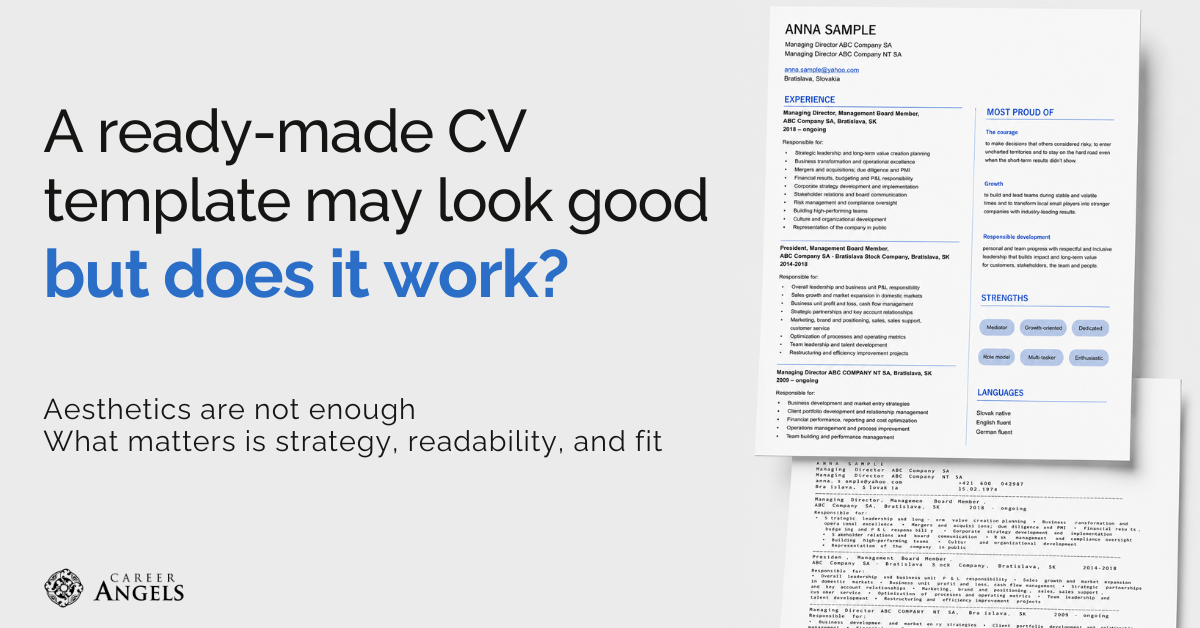
Why a CV Template Doesn’t Always Work in a Candidate’s Favor
Ready-made CV templates seem like a simple and safe solution. All you need to do is choose an attractive layout, insert your work experience, export the document to PDF, and your CV looks modern and professional.
For many experienced managers, executives and experts, this is tempting, especially when they want to quickly refresh the document or give it a more modern look. In practice, however, aesthetics don’t always translate into effectiveness.
A CV isn’t a graphic design project. It is a tool that should help a recruiter, headhunter or decision maker quickly understand what type of role you are suited for, what value you can bring, and why it is worth inviting you to an interview.
The more complex your career is, the more important it becomes to select the right information, organize the content effectively, and ensure clear positioning. A template can help you organize the document visually, but it won’t make strategic decisions for you, such as what to highlight, what to shorten, what to move lower, and what to leave out.
A Template Organizes Information, But It Doesn’t Build a Strategy
Most CV templates follow a similar structure: a brief professional summary, work experience, education, skills, languages, and certifications. This layout may seem logical, but that doesn’t necessarily mean the document positions you well.
At the managerial and executive level, a CV shouldn’t be just a chronological summary of your career. It should show where you are heading professionally and why your experience matters from the future employer’s perspective.
Your CV will look different depending on whether you want to move from an operational role into a more strategic one, change industries, prepare for a regional role, or emphasize your experience in transformation, restructuring, scaling organizations or improving efficiency.
A ready-made layout doesn’t distinguish between these situations. It gives you space for text, but it doesn’t answer the question of what professional story should emerge from that text.
An Attractive Layout May Highlight the Wrong Elements
In many templates, a significant part of the document is taken up by sections that make a good visual impression, but don’t necessarily strengthen your candidacy. They often include extensive skills panels, skill level charts, icons, lists of general traits, or elements that help fill space rather than build an argument.
Terms such as leadership, communication, teamwork, or problem solving may look professional, but from a decision maker’s perspective, they usually don’t say much. For an experienced manager, what matters more is the scale you managed, the decisions you made, the results you achieved, the problems you solved, and the business context in which you operated.
If the most valuable information is moved lower or shortened only so that it fits into a predefined layout, the CV may not show your advantage clearly enough.
A Template Often Flattens Achievements
Templates look best when the text is short, even, and symmetrical. In practice, this encourages candidates to insert general statements into their CV rather than specific results.
Consequently, CVs often include phrases such as:
“team management”,
“budget responsibility”,
“process optimization”,
“collaboration with stakeholders”.
They aren’t incorrect themselves. The problem is that without context, they don’t show your value.
At the managerial and executive level, what matters is scale, impact, and outcomes. How large was the team you managed? What budget were you responsible for? What changed as a result of the optimization? What was the outcome of the project? What risk were you able to reduce? What business challenge was solved?
A ready-made layout rarely helps bring out this kind of information. More often, it forces you to be brief, removing from your CV the very details that could decide whether you’re invited to an interview.
A CV May Be Readable for a Human, But Not for the System
This is one of the problems we see very often in documents prepared in popular graphic design tools.
A CV may look professional as a PDF: it may have modern typography, elegant spacing, colors, and a clear layout. However, in many recruitment processes, the document isn’t assessed only by a human. It also passes through an ATS system, which reads the text layer: sections, dates, job titles, skills, and keywords.
That is why the document’s appearance alone isn’t enough. What also matters is whether the text saved in the PDF remains readable after it is separated from the graphic layer. This can be checked easily by copying the content from the file into a simple notepad.
In practice, this is often when the problem becomes visible: instead of special characters, random symbols appear, individual letters are missing, some words are distorted, there is a space between every letter, and parts of the text look like encrypted code. Sometimes, the order of the content is illogical or part of the document is treated as a graphic element rather than text.
An example? The job title:
“Director of Strategy and Development”
after being copied into a notepad may look like this:
“D i r e c o r o f S r a e g y a n d D e v e l o p m e n”
showing missing letters, unnatural spacing, and a distorted version of the job title.
In another document, the system may first read the side column with skills, then the section of work experience, followed by the contact details, and only then the job title. For the person opening the PDF, everything looks fine. For an ATS, however, such a document may be only partially understandable.
If the system fails to recognize the job title, skills, industry, technologies, scope of responsibility, or keywords from the job ad, you may lose the chance to move to the next stage, even though your experience is relevant.
This isn’t just a minor technical issue. You may have the right skills, but if your CV doesn’t communicate them in a way that is clear to both systems and people, your chances decrease right at the beginning of the process.
A Template Doesn’t Answer the Question: “Why You?”
A good CV shouldn’t just inform the reader where you worked and what you were responsible for. It should help them quickly understand why it is worth talking specifically to you.
For experienced candidates, the competitive advantage often doesn’t come from a single role, but from a combination of several elements:
- experience in transformation,
- change management,
- working in a challenging market environment,
- building structures from scratch,
- scaling a business,
- optimizing costs,
- entering new markets,
- combining several areas of expertise, such as finance and digitalization, or HR and workforce planning.
This type of advantage needs to be named and shown in the right context. If your CV remains only a list of roles and responsibilities entered into a ready-made layout, the recipient may not see what is most important in your career.
A template can help organize the document. However, it won’t replace analysis, selection of information, and decisions about which elements of your experience should be emphasized most strongly.
When Should You Be Particularly Careful With Templates?
A ready-made template can be particularly risky when you have more than 10 years of experience, a varied career history, are aiming for managerial or executive roles, or are changing industry, function, or level of responsibility.
It’s also worth being cautious when your most recent role doesn’t fully show the direction in which you want to go next, or when your CV looks good but doesn’t generate interview invitations.
In such situations, the problem is rarely the design itself. More often, the issue is that the document doesn’t show your value, career direction, or fit with current market needs clearly enough.
A CV Should Result From Strategy, Not From a Template
This doesn’t mean that a CV has to be boring, outdated or lacking in aesthetics. A good document can be elegant, modern and clear. However, the form should support the content, not replace the strategy.
First, you need to define your career goal, realistic target roles, market expectations, and those elements of your experience that best demonstrate why you are suited to the roles you have chosen. Only then should you decide on the structure, layout and tone of your CV.
So, if your CV looks good but isn’t getting the results you’d hoped for, it’s worth asking yourself whether it actually supports your career strategy and whether the reader can quickly see which roles you’re suited to and why it’s worth inviting you to an interview.
How Can You Check What Is Blocking the Effectiveness of Your CV?
At Career Angels, we work with managers, executives and experienced professionals who want to position themselves better on the job market. We help assess whether your CV aligns with your career goals, highlights the aspects of your experience that are relevant to your chosen roles, and increases your chances of being invited for an interview.
The first step could be a free, confidential online Career Consultation. During the conversation, we’ll discuss your situation, professional direction, and whether your current CV supports your next step. If it turns out that your CV needs restructuring, we can offer further support in preparing a CV aligned with the market, the role, and your career strategy.
To schedule a consultation, send your CV and a short description of your situation to Contact@CareerAngels.eu. In the subject line, write: “Career Consultation / CV”.
Sometimes, a few well-chosen changes to a CV are enough to make previously unclear experience visible to the market.