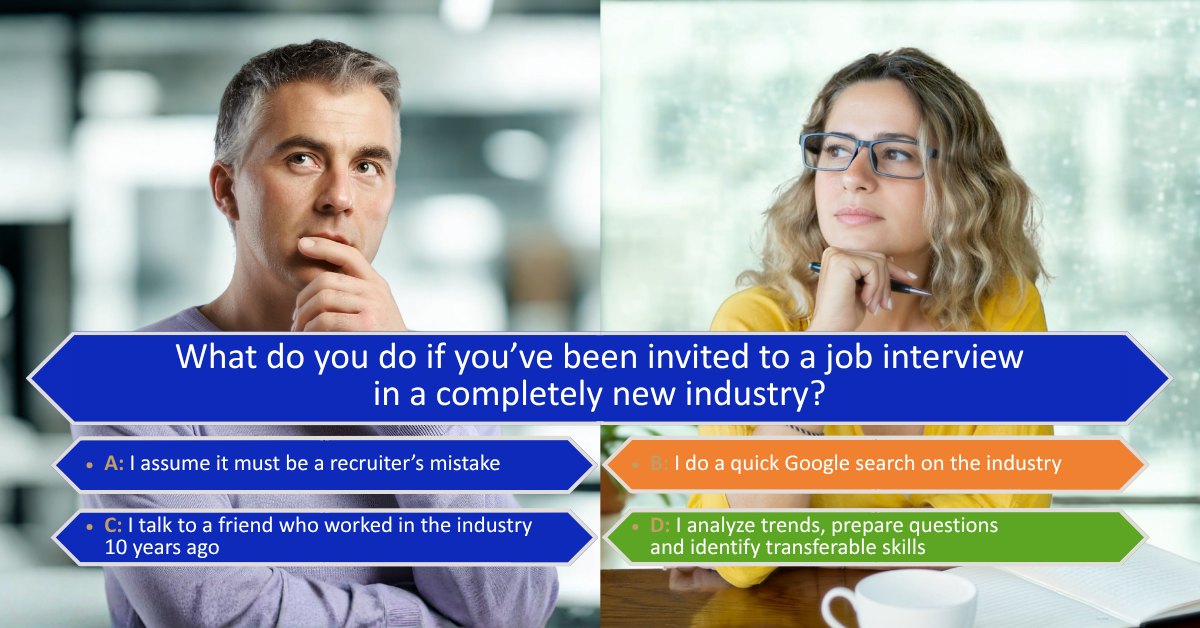
What do you do if you’ve been invited to a job interview in a completely new industry?
“Does my experience even matter in this industry?
How much do I need to know about the sector before the first interview?
Does having no industry experience automatically put me at a disadvantage?
Which of my skills could actually be useful in a new environment?”
Being invited to a job interview in an industry you have never worked in before can quickly raise doubts. Are you really a good fit? Will you be able to have a meaningful conversation about the market? Don’t other candidates have an obvious advantage over you?
For experienced managers and executives, however, changing industries doesn’t have to mean starting everything from scratch. In many roles, what matters is not only sector knowledge but also experience in running a business, leading transformations, scaling organizations, managing P&L, managing change and working with complex stakeholder groups. The key is whether you can apply your existing experience to the needs of the new environment.
Let’s look at the options you have when you’re invited to a job interview in a completely new industry.
1. Assume it must be a recruiter’s mistake
Why it may not work: You may immediately assume that candidates with industry experience have the upper hand and that you have little chance of succeeding. Yet if the company invited you to an interview, someone has already seen something in your profile worth exploring. Focusing only on what you don’t know may mean that you fail to show what you can actually bring to the table. At executive level, much of the experience gained in one industry can also be highly valuable in a different business context.
2. Do a quick Google search on the industry
Why it may not work: Basic research is of course better than none, but a few articles, the company website and a quick look at the biggest players will only give you a superficial view of the industry. You may learn some basic terminology and become familiar with a few current issues, but during the interview it will quickly become clear whether you really understand the dynamics of the sector, its key challenges and the company’s business model. For senior-level roles, a quick Google search is not enough. You should prepare for a conversation about the business, not just for using industry jargon.
3. Talk to a friend who worked in the industry 10 years ago
Why it may not work: Talking to someone who knows the sector can provide valuable context, but one person can’t give you the full picture of the market, especially if they worked in the industry several or even more than ten years ago. In that time, business models, regulations, technologies, customer behavior and the competitive landscape may all have changed. Networking can be a good complement to your preparation, but it shouldn’t replace your own analysis and the use of up-to-date sources. Such a conversation can help, but it shouldn’t be your only source of preparation.
4. Analyze trends, prepare questions and identify transferable skills
Why it may not work: You can also go too far in the other direction. If you try to become an expert in a new industry in just a few days, you can easily get lost in reports, podcasts and analyses that won’t matter much during the interview. You may also focus so heavily on learning about the sector that you forget the most important question: why did the company invite you specifically?
When it may work: If your research has a specific purpose. You don’t need to know everything about the industry, but you should understand its structure, main trends, competitive landscape, key challenges and the company’s business context. Then consider which elements of your experience best match that context: leading transformations, P&L responsibility, scaling operations, entering new markets, change management, team building, restructuring, digitalization or working with complex stakeholder groups. These transferable skills may be one of the reasons the company decided to interview you. If you find it difficult to judge on your own which parts of your experience will be most convincing in this particular industry, a meeting with a Career Consultant can help you structure your arguments and prepare for the questions that are likely to come up during the interview.
5. Try to hide the fact that you don’t know the industry
Why it may not work: Trying to come across as an expert in a sector you have never worked in can quickly undermine your credibility. An experienced CEO, hiring manager or recruiter specializing in the industry will probably notice where your knowledge ends. It’s better to be clear about what you still need to learn while being specific about what you can already contribute. Credibility isn’t about pretending to know all the answers. It’s about being able to learn quickly, ask the right questions and show how your existing experience applies to a new business situation.
6. Prepare standard answers to interview questions
Why it may not work: Standard interview preparation may not be enough if you are changing industries. You still need to be able to talk about your achievements, management style and motivation, but the interviewer will probably want to understand something more: why you could succeed in this particular environment. Generic answers such as “I’m a quick learner,” “I enjoy new challenges” or “I have extensive management experience” won’t be enough. You need concrete examples showing when you have successfully adapted to a new context, learned a complex business or transferred solutions across markets, functions or organizations. The point isn’t to prove that you can succeed anywhere. It’s to show why you can succeed here.
7. Assume that since the company invited you, your lack of industry experience doesn’t matter
Why it may not work: An interview invitation is a positive sign, but it doesn’t mean that sector experience has stopped mattering. On the contrary, it may be one of the main topics of the meeting. The company may be checking whether your experience from another sector can really be applied to its needs and challenges. So prepare clear, specific answers to questions about your motivation for changing industries, the most relevant elements of your experience, how quickly you can learn about a new market and any doubts the company may have about your candidacy. Don’t avoid the issue. Instead, show that you have thought it through yourself.
So, what’s the best option for a Senior Professional?
Given who has prepared this post, you know what we’ll suggest ;)
Ask a Career Consultant who specializes in working with experienced professionals and executives for advice. Someone who will:
- help you assess which skills and achievements are truly transferable,
- help you apply your existing experience to the needs of the new industry,
- prepare you for questions about your lack of sector experience,
- help you determine what you really need to know about the industry and the company before the interview.
Over the past 5 years, we have advised 4,863 experienced managers and executives who expected a straight answer – and got one! What’s more, over 80% of our clients come to us through recommendations.
If you are a senior professional, reach out to Career Angels at Contact@CareerAngels.eu to book a free* Career Consultation and talk about preparing for an interview in a new industry, changing your career direction or any other career-related topic.
* Why is it free?
That’s a real question we sometimes receive, as “free probably means that there’s no value”.
Our thinking is slightly different: we know how many “people” try to sell something to executives or want something from you. And by “people”, we mean: service providers, sales representatives, consultants, current or former or potential employees… We believe that if we do a great job during our first consultation, you’ll see the value and hire us.
For us, that’s a fair deal. What say you?