
Headhunters in Job Search Strategy: How This Channel Works and What to Expect from It
You contact headhunters, send your CV to Executive Search firms and occasionally have a conversation, but nothing happens in the weeks that follow. You may then conclude that this channel simply doesn’t work. The problem, however, may lie not in the channel itself, but in what you expect from it and how you use it.
Executive Search firms are one of the four main channels worth including in the job search strategy of experienced managers and executives. At the same time, the way they operate differs significantly from applying for job ads, networking or contacting companies directly.
One of the most common misunderstandings is the assumption that it’s enough to send your CV to several Executive Search firms and wait for the right opportunity. In practice, the headhunter’s client isn’t the candidate, but the company that has commissioned them to find someone for a specific position. A consultant therefore doesn’t look for a job for every person who enters their database. They look for candidates who match the requirements of the specific recruitment assignments they are handling.
Understanding this difference helps not only to use this channel more effectively, but also to assess its effectiveness realistically.
What Role Do Executive Search Firms Play in a Job Search?
At Career Angels, we’ve been analyzing which channels our clients’ accepted job offers come from for years. The data relates to experienced managers and executives, not junior or specialist positions.
Over the years, the share of Executive Search firms has changed significantly. In 2016, they accounted for 31% of the job offers accepted by our clients, while three years later the figure had fallen to just 8%. Their share then increased again to 19% in 2020 and remained in the teens in the following years: 12% in 2021, 13% in 2022, 18% in 2023 and 16% in 2024.
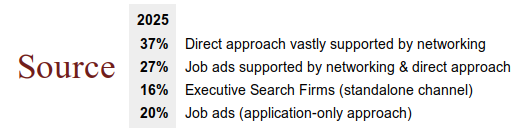
In 2025, we changed the way we analyzed channels because an accepted offer was increasingly the result of combining several channels. A candidate might, for example, apply for a job ad and then contact the decision maker or use networking. Executive Search firms continued to work as a standalone channel and accounted for 16% of accepted job offers.
What Do These Numbers Tell Us?
The data shows three things above all:
- Executive Search firms continue to generate a share of the job offers accepted by our clients,
- the share of this channel in accepted offers changes depending on market conditions, the number of active search projects and the types of profiles being sought,
- its effectiveness shouldn’t be assessed solely on the basis of a short period of activity.
It therefore doesn’t make sense to base the entire strategy exclusively on headhunters. At the same time, a lower share of this channel in accepted offers in a particular year doesn’t mean that it’s no longer relevant.
A Headhunter Doesn’t Start with Your CV
An Executive Search project starts with a specific recruitment need. The company defines the profile it needs: seniority level, functional and industry experience, location, competencies or the scale of previous responsibility.
Only then does the consultant begin the search: identifying companies where suitable people may work, reaching out to potential candidates and gradually narrowing the pool down to those who best match the client’s requirements.
From the perspective of someone looking for a job, this means something very important: you may have a strong profile, the right experience and a well-prepared CV, and still not match any of the projects being handled by a particular consultant at that moment. A lack of response therefore doesn’t necessarily mean that your profile has been assessed negatively. It may simply not match any of the projects that consultant is handling at that time.
This is why it’s worth looking at this channel not only by asking, “does this headhunter have a job for me right now?”, but also, “do I want them to know my profile when the right project comes along?”
It’s Not Only the Firm That Matters, but Also the Right Consultant
Simply preparing a list of the best-known Executive Search firms isn’t enough. Finding the right person within the organization is equally important.
Consultants specialize in different industries, functions, levels of seniority and regions. Someone working in Consumer & Retail won’t be handling CFO searches for industrial companies. A consultant specializing in HR won’t be the right contact for someone interested in a Sales Director role.
This is why, when selecting headhunters, it’s worth checking:
- which industries they run searches in,
- which functions and levels of seniority they recruit for,
- which geographical markets they cover,
- whether their specialization genuinely matches your profile and career direction.
In larger markets, we usually recommend preparing a list of around 30-50 relevant headhunters per country. The number itself, however, isn’t the goal. A shorter, well-selected list will be more valuable than a larger group of random contacts.
This is particularly important if you operate across several markets or are considering several directions. Before you start writing messages, you should know why you are contacting a particular person.
How to Write to a Headhunter
The first message shouldn’t be a second CV. Its purpose is to clearly communicate your desired next career move and highlight, in a few bullet points, the most important elements of your professional profile (areas of specialization).
It’s therefore worth including:
- the target position or level of the role,
- 2-4 of the most important elements of your experience,
- any relevant constraints or preferences, for example willingness to relocate.
Instead of writing: “I am sending my CV and would appreciate it if you contacted me should a suitable opportunity arise”, you could write:
Dear [Name],
I am planning my next career move and exploring opportunities at General Manager / Managing Director level in the DACH region.
My profile in brief:
– over 15 years of experience managing manufacturing organizations,
– experience in transformation projects in […],
– […]I have attached my CV with a more detailed description of my experience and achievements.
If you are currently working on projects that match this profile, I would appreciate hearing from you.
[…]
Such a message doesn’t tell your entire career story, but it gives the headhunter a clear picture of your areas of specialization and the types of projects they may be able to match you with.
How to Measure the Effectiveness of Contacting Headhunters
If you don’t receive a response to your first message, follow up. We usually recommend doing so after 7-10 business days.
At Career Angels, we monitor results including Response Rate (RR), meaning the percentage of contacts that generate a response, and Interview Rate (IVR), meaning the percentage of contacts that lead to a conversation with a headhunter.
For well-prepared outreach, the market benchmarks are a 30-50% Response Rate and a 5-10% Interview Rate.
If, after contacting a sufficiently large group of headhunters, the results remain significantly below these benchmarks, it’s worth reviewing the entire process. The problem may be an incorrectly selected group of consultants, an overly broad career goal, unclear positioning, the way experience is presented in the CV or an ineffective first message.
So instead of concluding that “headhunters don’t respond to me”, it’s worth first checking how many of the right people you have actually reached and what objective results these activities are producing.
It’s Worth Building Relationships with Headhunters Earlier
The Executive Search channel is part of a long-term strategy. A contact made today doesn’t have to lead to a conversation about a job next week, but it may become relevant when, several months later, the consultant receives a project that matches your profile.
We see clients receiving job opportunities from headhunters long after their initial contact. In our work, we have repeatedly observed that some of them accept offers received through this channel even several months after their cooperation with Career Angels has ended.
It’s also worth maintaining these relationships and reconnecting with relevant consultants when your professional profile changes significantly. A change of position, a broader scope of responsibility, entering a new market or completing an important project can all be good reasons to get in touch again.
The point is therefore not to keep asking, “Do you have anything for me?”, but to build relationships strategically.
Headhunters Are Only Part of the Strategy
Executive Search firms can provide access to confidential or strategic projects that often don’t appear in public job ads. This doesn’t mean, however, that it makes sense to wait exclusively for a call from a headhunter.
Our data increasingly shows that job searching at the level of experienced managers and executives is a multichannel process. Job ads, direct contact, networking and Executive Search firms can lead to different opportunities, but increasingly they also support one another.
So instead of asking which channel is “the best”, it’s worth asking a different question: are you using each of them in the right way, with the right level of intensity and at the right time?
Are You Using the Executive Search Channel Effectively?
Perhaps you already have a list of headhunters and are taking regular action, but you don’t know whether you are reaching the right people, whether your profile is clearly positioned and whether you are using this channel effectively as part of a broader job search strategy.
If you are a manager or executive with at least 10 years of experience and would like to review your job search strategy, email Contact@CareerAngels.eu with “Career Consultation / Blog” in the subject line, attach your CV and schedule a free, confidential online Career Consultation.
In Executive Search, the right opportunity may not arise for several months. This is why it’s worth making sure that the right headhunters know your profile before a project that may be a good fit reaches them.